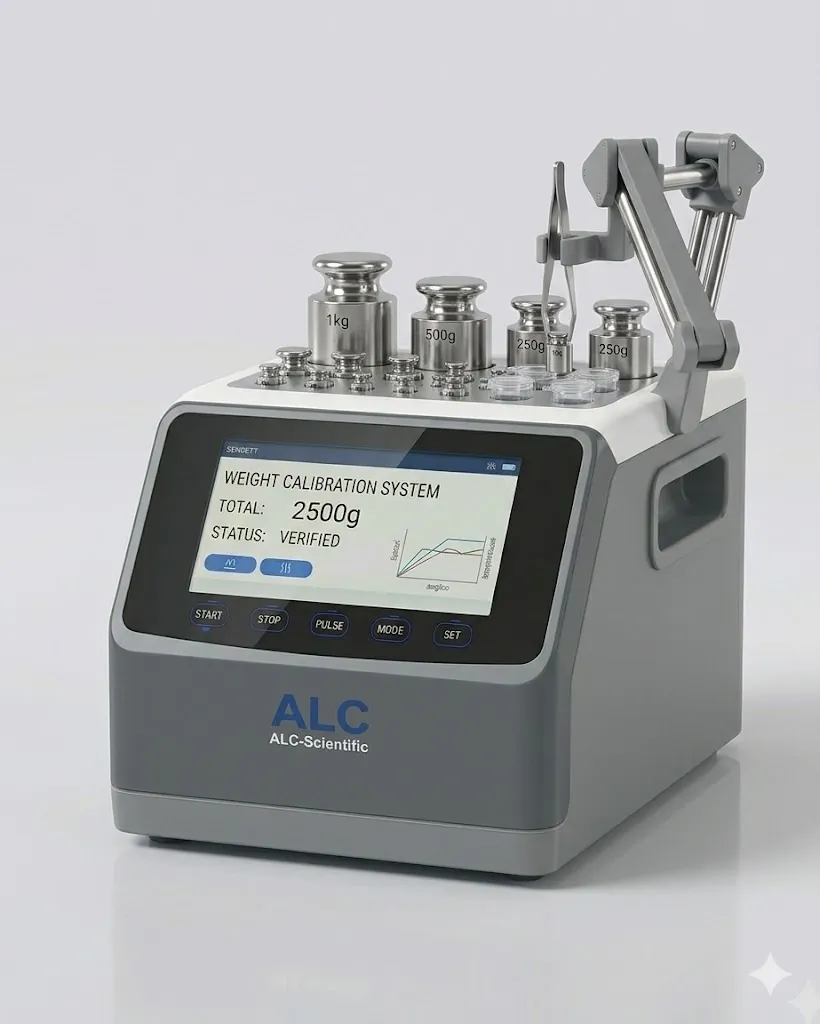
Calibration weights provide known reference masses for balance checks or calibration activities, subject to the selected accuracy class, certificate status and handling procedure. Typical uses include daily balance checks, calibration support, and method verification.
A calibration weight provides a known reference mass for checking or calibrating a balance. The selected nominal value, accuracy class, handling method and certificate status determine how it can be used within the laboratory quality procedure.
Where Calibration Weights fits
Suitable measurements
Calibration Weights is commonly shortlisted for Daily balance checks, Calibration support, and Method verification. These uses orient the Calibration Weights enquiry; suitability still depends on the exact model, method and site conditions.
Specify method, range and sample conditions
For Calibration Weights, the enquiry should document Balance capacity, readability and the purpose of the check or calibration and Required nominal masses and accuracy class for the laboratory procedure. Acceptance values for the proposed Calibration Weights should come from the buyer's method, URS or tender rather than catalogue assumptions.
Confirm calibration and measurement evidence
Ask for the exact Calibration Weights model, measurement range, resolution or readability, stated accuracy or uncertainty where applicable, calibration method, included sensors or accessories, power requirements and datasheet revision.
Typical applications for Calibration Weights
Daily balance checks.
Calibration support.
Method verification.
Quality-system documentation.
Selecting the right Calibration Weights
Application or load: Balance capacity, readability and the purpose of the check or calibration.
Required performance: Required nominal masses and accuracy class for the laboratory procedure.
Configuration and compatibility: Certificate type, traceability statement and recalibration expectations.
Site, utilities and support: Case, forceps or handling tools, storage conditions and cleaning restrictions.
Operating limits and safety for Calibration Weights
Handle higher-class weights with forceps or gloves.
Do not polish, grind or alter a calibration weight.
Allow weights to stabilize in the weighing environment before use.
Store each weight in its protective case when not in use.
Documents to review for Calibration Weights
The catalogue discussion of Calibration Weights, including certificate type, traceability statement and recalibration expectations, does not establish guaranteed values or model approval; request the offered model, revision and evidence package before sign-off.
Product information scope
Calibration Weights selection guidance; the exact model is confirmed in the quotation
Model reference
Assigned for Calibration Weights in the quotation or approved datasheet
To prepare a model-level quotation for Calibration Weights, provide Balance capacity, readability and the purpose of the check or calibration; Required nominal masses and accuracy class for the laboratory procedure; Certificate type, traceability statement and recalibration expectations; required quantity; delivery and installation location; and the technical evidence, training or service scope needed for approval.