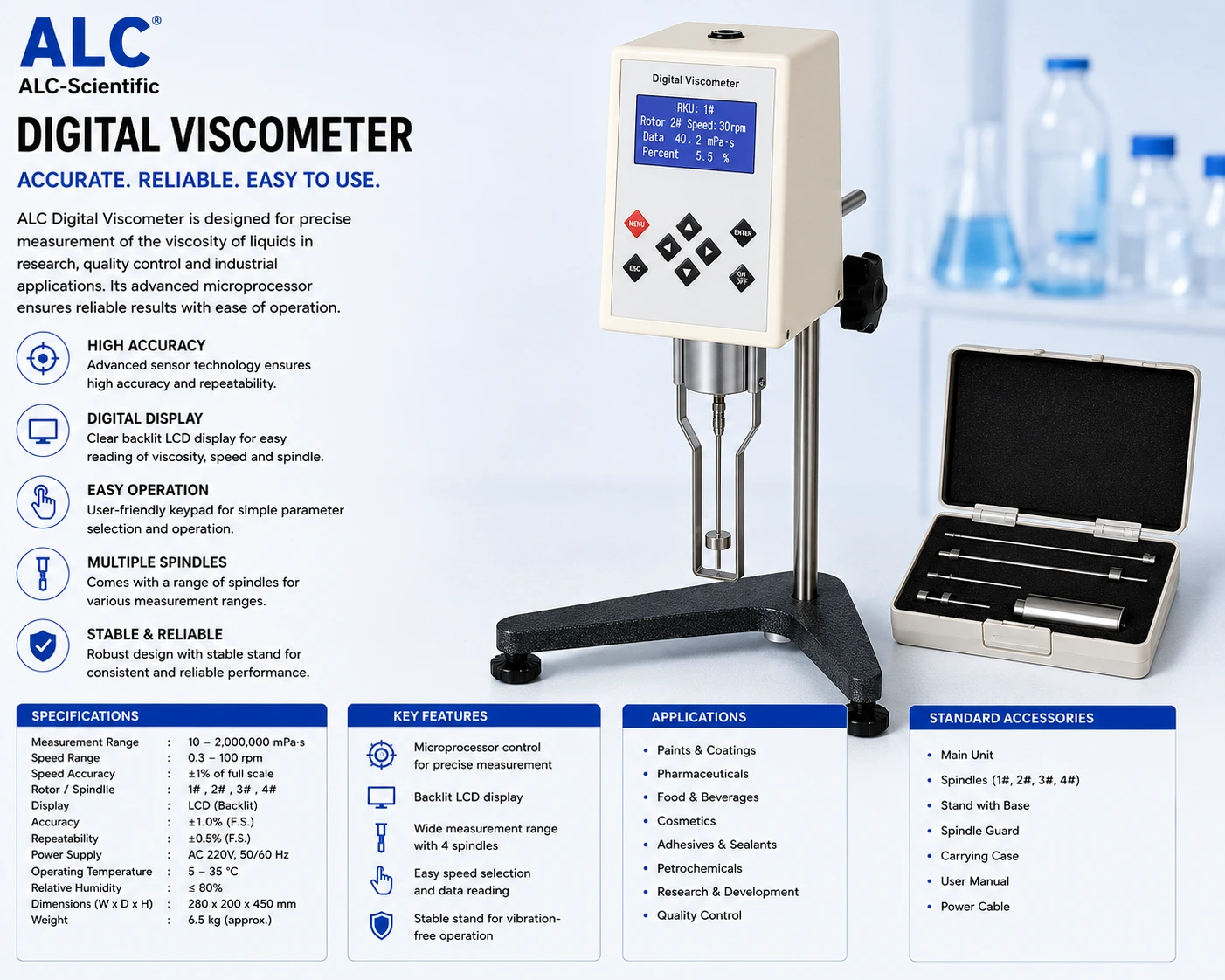
A digital viscometer measures resistance to controlled spindle or measuring-element movement and converts the resulting torque into a viscosity value for the stated method conditions. Typical uses include formulation development, incoming raw-material testing, and batch consistency checks.
A spindle or measuring element moves through the fluid at a controlled rate. Resistance to that motion produces torque, which the instrument converts to viscosity using the selected spindle, speed and method conditions.
Where Digital Viscometer fits
Suitable measurements
Digital Viscometer is commonly shortlisted for Formulation development, Incoming raw-material testing, and Batch consistency checks. These uses orient the Digital Viscometer enquiry; suitability still depends on the exact model, method and site conditions.
Specify method, range and sample conditions
For Digital Viscometer, the enquiry should document Sample viscosity range, temperature and shear sensitivity and Spindle or measuring geometry and the speed combinations needed by the method. Acceptance values for the proposed Digital Viscometer should come from the buyer's method, URS or tender rather than catalogue assumptions.
Confirm calibration and measurement evidence
Ask for the exact Digital Viscometer model, measurement range, resolution or readability, stated accuracy or uncertainty where applicable, calibration method, included sensors or accessories, power requirements and datasheet revision.
Typical applications for Digital Viscometer
Formulation development.
Incoming raw-material testing.
Batch consistency checks.
Rheological screening.
Selecting the right Digital Viscometer
Application or load: Sample viscosity range, temperature and shear sensitivity.
Required performance: Spindle or measuring geometry and the speed combinations needed by the method.
Configuration and compatibility: Minimum sample volume, vessel geometry and temperature-control accessory.
Site, utilities and support: Calibration reference, method reporting, data export and cleaning procedure.
Operating limits and safety for Digital Viscometer
Viscosity is strongly temperature- and method-dependent.
The correct spindle and torque range must be used for the sample.
Non-Newtonian materials require a defined shear history and reporting procedure.
Documents to review for Digital Viscometer
Because Digital Viscometer selection includes minimum sample volume, vessel geometry and temperature-control accessory, no orderable model specification is inferred from this page and the quotation must identify the applicable technical document.
Product information scope
Digital Viscometer selection guidance; the exact model is confirmed in the quotation
Model reference
Assigned for Digital Viscometer in the quotation or approved datasheet
Supply responsibility
Must be stated for the quoted Digital Viscometer
Technical evidence
Revision-controlled Digital Viscometer document required
To prepare a model-level quotation for Digital Viscometer, provide Sample viscosity range, temperature and shear sensitivity; Spindle or measuring geometry and the speed combinations needed by the method; Minimum sample volume, vessel geometry and temperature-control accessory; required quantity; delivery and installation location; and the technical evidence, training or service scope needed for approval.